Mom Rabbit Decide My Dogs Yard was Home
July 24, 2026
I live in a rural community and have tons of fields and woods around me/nearby. I also have 2 dogs, one is rather large and the other is a hunter - Jack Russell Terrier. Both dogs like to "hunt" or rather chase animals that enter our yard, and that includes the Robins that make up to 10 nests either under outside nooks or nearby trees. Over the years the Robins have harrassed my dogs - they get close to them, once the dogs see them and chase, they move somewhere else. This can go on for hours and hours. The dogs love it and Robins do as well.
However, one early afternoon, the dogs were in their dog run - a really large pen where they do their business - and they were really quiet and not hanging out with us. So I went to investigate. The Jack's snoz was hard at work, smelling the ground like he was searching for treasure. And treasure he found. A Mom rabbit had decided to build its shallow nest in our dog run! Honestly, my first thought was what kind of stupid animal has their babies in an area where dogs always are...then I thought, other than the dogs it's the most protected part for miles.
I contacted our local Wildlife Association to ask them what I should do. Well I contacted more than one as I really didn't like the advice. But each one said the same thing. Leave them alone, don't let the dogs use the run for at least 3 weeks, and don't under any circumstances, try and "help" them by bringing them inside.
Some context before I continue:
- They are Eastern Cotton Tails.
- She digs a shallow nest and buries her babies coming back in the early morning and early evening to feed them
- It takes about 3-4 weeks before they become truly mobile and start to fend for themselves
- Kits can be from 3 - 15 babies.
- I have raised all kinds of hurt wild animals in my life.
This advice didn't just come from one person or Association, it came from all of them. So now, I had to either take my dogs out on a leash to go the washroom, or I could go out with them each time and guard the nest. Of course, guarding the nest and leash would be the options I chose.
This went on for three plus weeks!
Finally, I started to see the babies out gallivanting around, playing in the long grass (I didn't cut the grass as I didn't want to hurt or kill them). Just when I thought that they had flown the coop so to speak, or "hopped the nest", I let the dogs back to their area. Unfortunately, the Jack got a hold of one and well, the "kit" became one less. I couldn't fault the Jack, this is their job - keep the vermin away - and they are really really good at it.
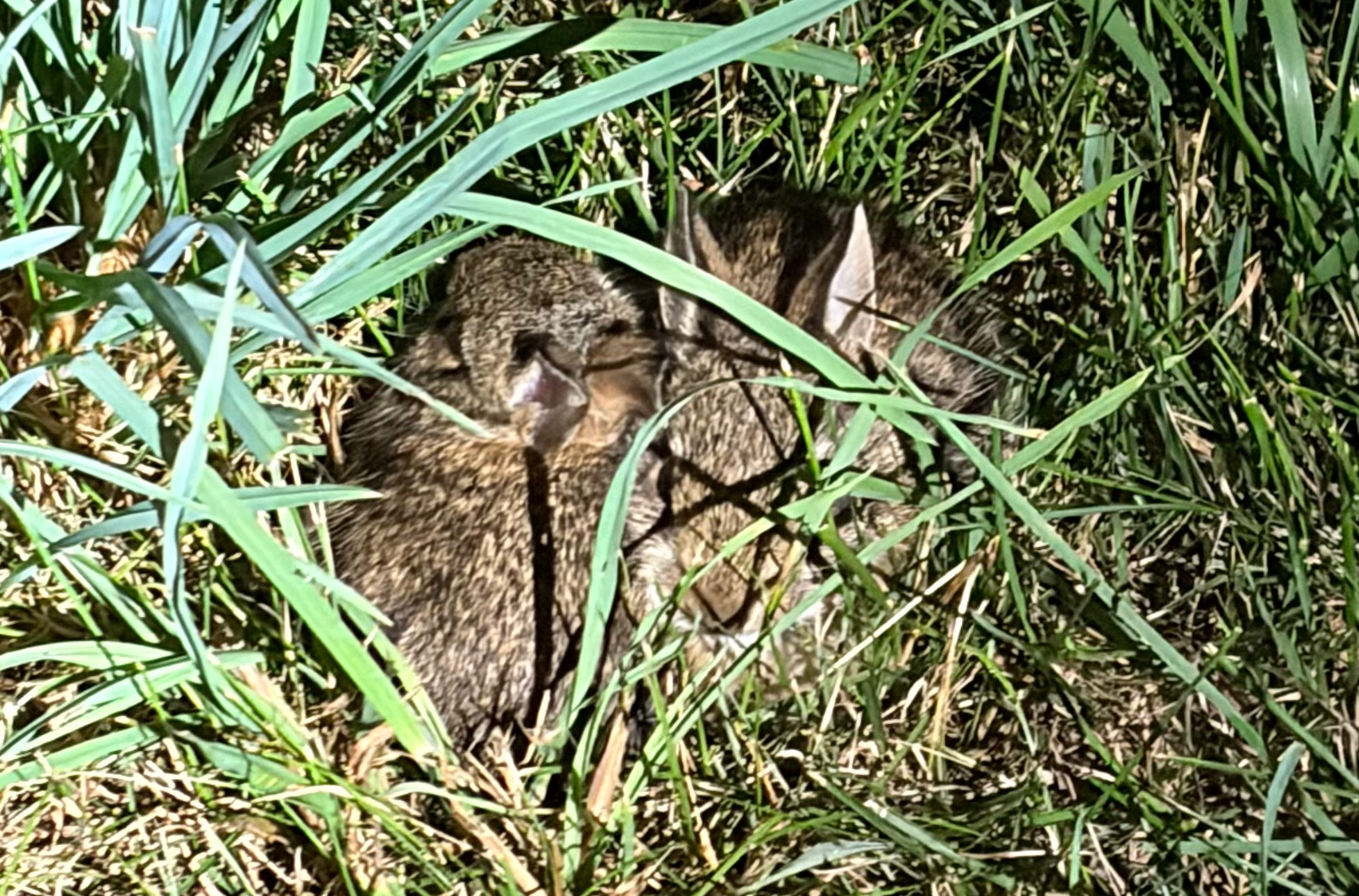
During the day, they escaped their nest and would go play, but at night they would be back. So I diligently checked and walked the run - it's big, so it always took awhile - to make sure there were no babies playing around. It came to the last few nights. I would do the same routine, go check to see if they had come back home to sleep after a long day of eating and playing. I wanted to share a picture of the two babies that came back to sleep for a few more nights before beginning their life.
This is an actual picture of the 2 little ones sleeping in our dog run
Here's what I actually learned after going down the rabbit hole :)
Where rabbits have their babies
Wild cottontail rabbits do not dig deep burrows. The mother creates a shallow depression in the ground (usually only a few inches deep) in grassy areas — lawns, gardens, under shrubs, or even out in the open. She lines it with grass and soft fur she pulls from her own body.
How the mom covers / “buries” them
After nursing, she carefully covers the nest with grass, dried vegetation, and more of her fur. This camouflages the nest so it looks like just a patch of ground. The babies stay hidden this way most of the time.
How often the mom feeds them
She only visits the nest twice a day — typically at dawn and dusk.
She stays just long enough to nurse (a few minutes), then covers the nest again and leaves. She spends almost no time near the nest during the day to avoid attracting predators. It’s completely normal not to see her at all.
Litter size (kits)
- Average litter: about 4–6 kits
- Typical range: 3–8 kits
- Possible extremes: as few as 1 or as many as 10–12 in rare cases
She can have multiple litters in a season (usually 3–4, sometimes more), and can even become pregnant again while still nursing the current litter.
The kits stay in the nest for roughly 2–3 weeks before they start leaving on their own (they’re independent by about 4–5 weeks, even though they still look small).