What I Actually Learned About LinkedIn (After Ignoring It For Years)
July 15, 2026
I learned something today about LinkedIn — and social media in general — that I hadn't thought of before. I have to start off by saying I don't really use it, though I like "X." What I learned is that LinkedIn is a genuinely good place to start a conversation and generate leads. People still like the idea of being DM'd as a form of personalized reach-out. I hadn't really thought of that, since most of my business relationships started with a face-to-face meeting IRL — not through "similar interests" or "industries." So it made me think about who actually uses LinkedIn now, and why.
I also found out that Facebook — which started out as a communication mechanism for the under-30 crowd — has now migrated to something closer to a geriatric form of communication. That may offend some people, but as you know, it is what it is. More on that in another post.
So let's start with LinkedIn. It's still considered the strongest B2B platform for professional networking. The key is that it's especially good for reaching decision-makers, generating leads through targeted outreach (including DMs), and building thought leadership. It is not "dead" or replaced. I have, however, noticed that it's evolved. More noise, more AI-generated content. The algorithm has shifted to favor authenticity and profile quality. It continues to work very well for personalized prospecting when done strategically.
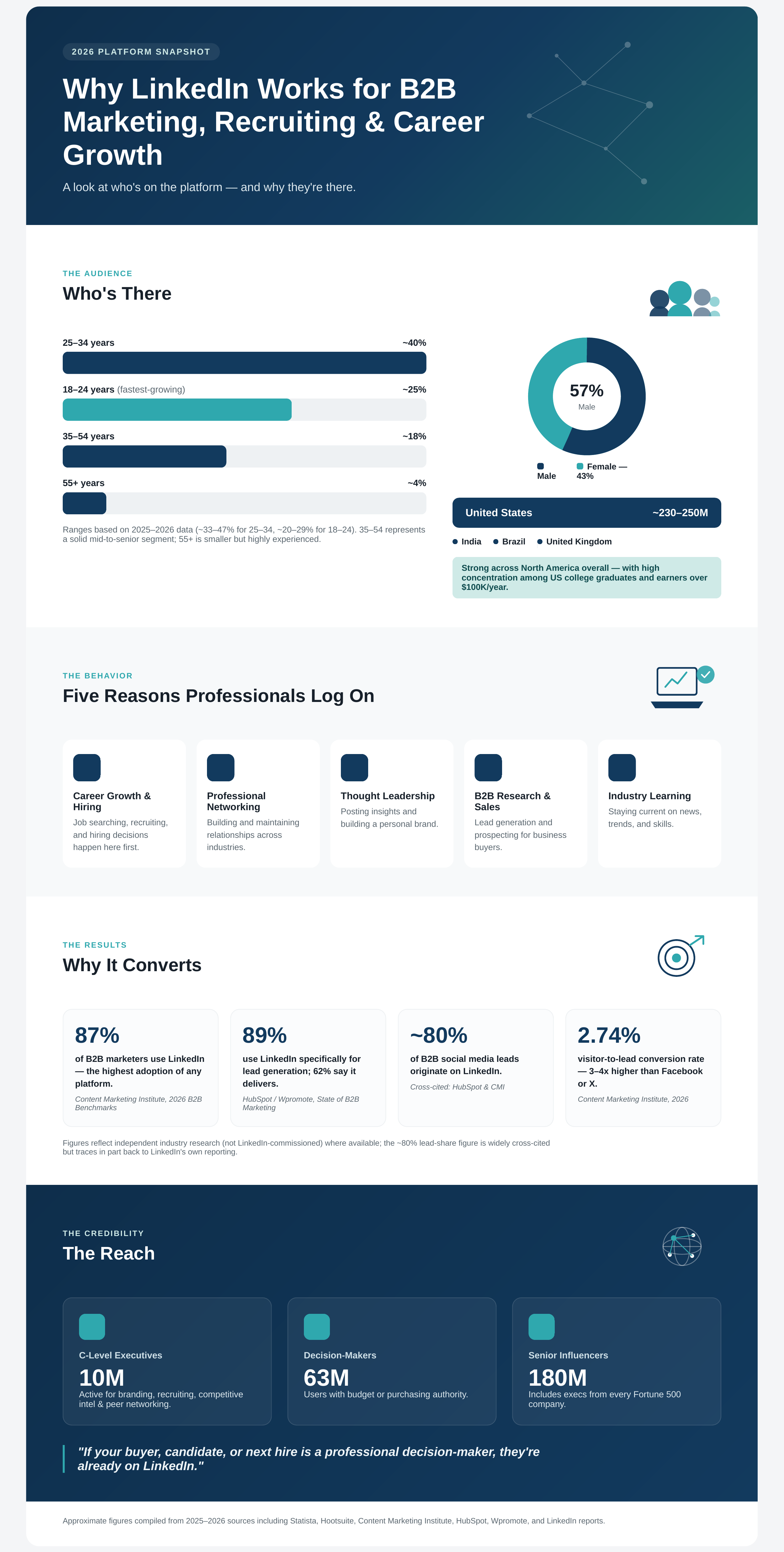
Why LinkedIn Works for B2B Marketing, Recruiting & Career Growth
Things to think about for 2026: the platform is noisier, with AI-generated posts and generic content leading to shorter attention spans and some fatigue. The algorithm has shifted to reward profile strength (complete history, verified skills, specific recommendations), authentic value, and "operator credibility" over sheer volume. Spammy or low-effort outreach underperforms, or risks restrictions. Success requires a value-first strategy of content or personalized outreach, not mass pitching.
It excels at high-intent conversations, credibility-building, and reaching decision-makers, unlike awareness-focused platforms (Facebook, YouTube). B2B marketers use it for content, prospecting, and account-based approaches. It is not a general social network. It concentrates higher-income, educated, career-oriented professionals and buyers/sellers in a B2B context.
Since I did, at one point, use LinkedIn with clear direction from someone who's a marketing guru, I knew professionals used it — but that was pre-COVID. I hadn't logged back in consistently since, and would say I open the app once a month at best. So the question is, are executives still using LinkedIn, and how?
Pew Research surveyed 5,022 US adults (Feb–June 2025): 32% use LinkedIn — well below the "1.3 billion members" figure often cited, since many registered profiles are inactive. Usage skews heavily toward college graduates and higher earners, and the trend has stayed relatively stable with modest growth.
Worth remembering as a gut check before trusting any platform's own numbers.
With 10 million C-level profiles* and decision-makers from every major company present, executives are active — or at least findable. There are really only four major uses they get out of it:
- Personal branding and thought leadership.
- Recruiting talent or partners.
- Monitoring industry trends and competitors.
- Networking with peers or potential collaborators.
Worth a caveat on that list before moving on.
CEOs posting personally get roughly 3x the engagement of corporate accounts.
That number mostly traces back to growth-agency and marketing blogs, not neutral research — same conflict of interest as LinkedIn's own membership numbers, just one layer removed. I also went back to verify "87% of recruiters call LinkedIn their most effective vetting channel" — the kind of number that gets repeated everywhere — and couldn't trace it to an actual source this time around. Cut it rather than keep a stat I can't stand behind. "Monitoring competitors" turned up no data at all either — that one's an assumption on my part, not a finding, so read it as such.
*That 10 million figure is LinkedIn's own number, echoed by Hootsuite and repeated everywhere else that cites it. I went looking for an independent source that measured it separately and didn't find one — every trail leads back to LinkedIn itself. Not disqualifying, just something to know you're standing on.
Outreach to executives works, but is more effective when warm. People like being engaged initially with likes on their content. Once you've shown genuine interest in the content, or the post, people notice. Interesting how intuitive this is. Think about it — you're out with colleagues and friends, and conversation often stems from people recognizing that you're interested in what they have to say. Digital technology doesn't take away from human nature.
I guess that's why cold pitches often fail. Too many unsubscribed emails, too many cold calls, too little time. Even I find that I'll take the time to delete emails from people I don't recognize. Negative prioritization :) Senior leaders lurk or post selectively for the same reason — time is valuable. This is what makes the platform work. One message, one DM that's genuine, shows real interest in a post, and gets a personalized response, can in fact lead to a connection.
Can we still use this platform the way we used to, or does the approach itself need to change?
Even today, many sales teams generate consistent pipeline through LinkedIn, often reporting stronger results than, or complementary to, cold emailing, as inboxes get saturated and people don't have time to review the hundreds of emails they receive daily. The key word there is "often." It isn't a silver bullet — just a tool in the toolbox, maybe the better one, but still a tool.
How should we approach creating connections that could lead to a sale? Maybe not a direct sale, but at the very least a lead — and, more modestly, an industry contact that increases your reach.
- Personalization is everything — research the person or company (recent posts, news, mutual connections, pain points relevant to their role or industry). Generic messages get ignored or reported.
- Content-led inbound often converts better long-term — posts that attract your ideal buyers.
- Multi-channel helps: LinkedIn plus email sequences or calls.
- Sales Navigator significantly boosts this with advanced search, lead recommendations, InMail credits (for non-connections), and tracking. Many teams see strong ROI*.
I left the Sales Navigator bullet for last.
The "strong ROI" figure behind it traces back to a Forrester Consulting study — commissioned and paid for by LinkedIn. The fine print shows those numbers came from large enterprise teams on the top-tier plan with dedicated SDRs, not the solo operator reading this on a Tuesday.
Not independent, whatever the report's letterhead suggests. Even I can be subject to reading a stat and making a conclusion.
*I went back and specifically looked for any Sales Navigator ROI research LinkedIn didn't pay for. Found nothing. Every figure in circulation — the 312%, the revenue numbers, all of it — traces to that same one Forrester study. Not "mostly LinkedIn-influenced." The only research that exists.
Based on this, a typical engagement flow would be as follows: Engage with content → Personalized connection request (with context) → Value-driven follow-up DM (insights, a relevant resource, a question — not a pitch) → Nurture.
We can't ignore that some buyers and connections are fatigued by volume outreach (I know I have become tired of the volume outreaches, and I can't tell you how many times I have hit "unsubscribe" and gone through that painful process), which causes reply rates to vary widely based on relevance and timing. Strong personalization and timing around buying signals improve outcomes dramatically.
- Connection request limits exist.
- Spam risks account health.
- The algorithm favors quality.
LinkedIn shouldn't be used in isolation. Like anything, if the only place you go to meet people is the library, you're limiting yourself. One approach that tends to work is to use LinkedIn as the core professional hub, then layer in other platforms and real-world contact. Think X for visibility, targeted emails once you've established a warm lead, and industry events or in-person meetings after that. The key is setting a rhythm of multi-touch outreach, which consistently outperforms single-channel activity.
Over the last few years, a number of things have changed or increased greatly. AI-generated content, termed "AI slop," is flooding feeds. Most people recognize this as disingenuous, just another form of mass emailing, and it's substantially reduced engagement. The good news is that LinkedIn, along with user activity, is pushing back against these low-value posts. The algorithm now favors profile completeness, verified skills, and authentic value over volume. Generic and spammy content is getting buried. I am still in the "wait and see" stage to determine if this proves successful.
Average visit duration has dropped to around six minutes. People are far more selective than they once were, partially because of outreach fatigue. Even I find DMs noisy and rarely personalized. It reminds me of the digital version of a cold call.
The key is having a plan for how you want to use the tools, the type of content you want to deliver, and making sure every interaction is genuine.
Now that we know what people do and don't like, the question becomes how to keep producing content that gets attention, delivers value, and stays authentic. It comes down to scannability and a few simple habits anyone can apply:
Practical Ideas:
- Strong hook in the first 1–2 lines: lead with a surprising fact, a direct question, or a specific pain point relevant to your audience. (Maybe like the "I learned something today" as the first line of this post?)
- Keep it short: aim for concise paragraphs, or use bullets and numbers. Most people skim; respect their time. (Note how this list is structured :)
- Deliver one clear takeaway: practical advice, a lesson learned, or an actionable observation beats vague commentary. Use specifics — data, examples, outcomes — instead of generic statements. (Note that this list is really a DIY.)
- Make it human: share real experience. Avoid overly polished, AI-sounding language — readers detect it. (Did I succeed at this in this article?)
- End with engagement: a simple question or prompt for comments encourages replies and boosts distribution.
- Profile matters too: complete, credible profiles — experience, skills, recommendations — improve how widely your posts reach.
Worth checking those against real data rather than taking them on faith. IMHO, I believe they mostly hold up, with one wrinkle.
Analysis of actual post performance found 61% of viral posts lead with quantified proof. Hooks under 60 characters outperform longer ones (0.42% engagement vs. 0.19% for hooks over 250 characters), while the post itself actually performs best north of 1,500 characters — beating short posts by roughly 49%.
Short hook, longer body — not just "keep it short," which is what the generic version of this advice usually says. And even that data comes from analytics vendors with their own tools to sell, so treat it as directionally useful, not gospel.
Post consistently with value-first content rather than promotion. Here's where I've always struggled — time runs away, and without a structured plan or a calendar reminder, I get caught up in my day and forget to engage on LinkedIn. Remember, all social media, not just LinkedIn (yes, I categorize it as social media), is a noisy environment, so be specific, helpful, and human, and you'll win attention and build credibility faster. The old adage still rings true: quality over quantity.
I can't help it when I see stats. I always question the stats or posts I read. A lot of the research I've presented so far could, at least in part, be a byproduct of marketing — LinkedIn providing stats about its own users, its own success. The Sales Navigator ROI number a few paragraphs back is the clearest example of that — a LinkedIn-funded study telling you LinkedIn's product works. I left it in on purpose, not to bury it, but because the same scrutiny has to apply to everything here, including what I write. Remember, this whole post is about getting attention, making connections, and hopefully catching your interest — so why would anyone assume the platform itself doesn't want the exact same thing: users, eyeballs, interactions. Including me.
I always want to take stats I find during research and validate them against discussions I've personally had, or by digging into places where real people are actually talking about how they use these platforms.
Here goes...
Declining reply rates on generic outreach:
A sales director at a Series C company sent 1,847 generic DMs in a month and booked 9 meetings — a 0.5% reply rate. In the same window, 40 highly personalized messages booked 4 meetings — a 10% reply rate, roughly the same time investment for a dramatically different result.
This one traces to an X post from Frederick Potticary, a LinkedIn outreach coach, recounting what a sales director showed him on his own dashboard. Not a formal study, not peer-reviewed — one person's account of one conversation, dated January 2026. Worth knowing before you weigh it the same as the research-backed numbers elsewhere in this piece. Generic templates are now widely ignored due to saturation regardless; highly personalized, context-specific messages performed dramatically better.
AI content fatigue:
Pangram, an AI-detection platform, found 41% of long-form LinkedIn posts (250+ words) are fully AI-generated, and 30% of shorter posts too. Independent outlets like 404 Media, The Register, and Fast Company have all reported on it, and LinkedIn's own VP and Executive Editor, Laura Lorenzetti, publicly admitted it: "When AI is overused... it dilutes the valuable insights that real human conversations can spark." LinkedIn has since pulled its AI writing assistant out of the post button and started algorithmically suppressing flagged content.
A platform admitting a problem against its own interest carries more weight than one bragging about a number. The "ineffective black hole" line on job applications traces to a Reddit thread picked up by a smaller blog — real sentiment, thinner source, so I'm not treating it with the same confidence as the Pangram number.
Broader sentiment: the "less effective" claim on cold DMs and InMail is backed by something harder than sentiment.
LinkedIn capped Open InMail sends in late 2025, cutting practical volume by roughly 87%, and raised the price of additional InMail credits from $3 to $21.
That's the platform admitting, through pricing and limits, that the old volume approach doesn't work the way it used to. The bit about senior executives mostly lurking rather than actively reaching out didn't turn up hard data either way, so this is an inference on my part, same as "monitoring competitors" earlier.
LinkedIn remains valuable for targeted, high-quality networking and thought leadership, especially among professionals and decision-makers. That was the real surprise here, given I'm not exactly a heavy user. Independent data shows more modest regular usage among US adults than the big member numbers suggest, and real-world user and sales feedback indicates that generic, high-volume tactics are losing effectiveness, thanks to noise, AI content, buyer fatigue, and algorithm changes that favor authenticity and relevance.
The platform still works — but it increasingly rewards quality over quantity.
Sources used in this post:
- Americans' Social Media Use 2025 — Pew Research Center
- LinkedIn Personal Profiles vs. Company Pages — Digital Applied
- 2025 LinkedIn Demographics — Hootsuite
- The ROI of Sales Navigator, According to Forrester — LinkedIn Sales Blog
- LinkedIn and X Are Flooded With AI Spam, Browsing Data Suggests — 404 Media
- AI Slop Writing Has Taken Over the Internet — The Register
- LinkedIn Declares War on AI Slop — Fast Company
- LinkedIn in 2026: From Desktop Trash Can to Job Search Nightmare — Digital Biz Talk
- Cold Email vs LinkedIn Outreach 2026 — GetReplies
- LinkedIn Algorithm Playbook 2026 — Linkpost
- Frederick Potticary (@freddiexpott) on X — anecdotal account of one sales director's dashboard, not a formal study.