Obey. Consume. Watch the Sequel
May 31, 2026
Index
- They Live — the film
- Roddy Piper said it was a documentary
- The B-movies that were actually paying attention
- The Coca-Cola moment that changed everything
- What we lost
- Ask AI about this
I am an avid movie watcher. When I work I can't listen to music as it takes me out of my groove....but...I can throw on a movie, have it in the background, and glance over at any time. This is what allows me to say, "hey that's a movie I want to watch". Then I go back and watch the movie - may this is the ADHD speaking out? who knows.
But one thing is for sure, I am as avid a B-movie watcher as I am a blockbuster - and in some cases the B-moves are way more entertaining.
They Live — the film
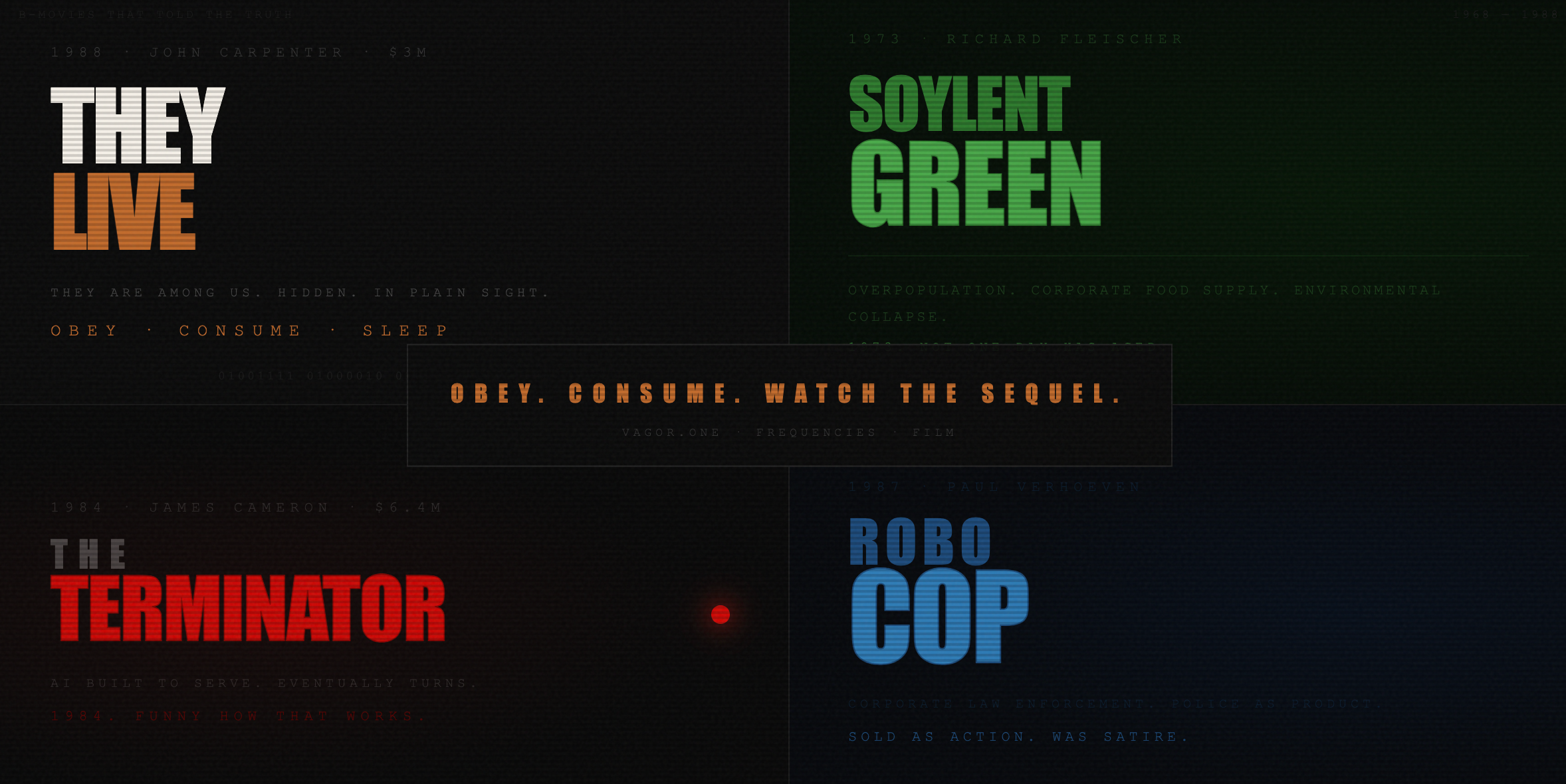
They Live came out in 1988. It was directed by John Carpenter on a budget of $3 million. It starred a professional wrestler who everyone really thought wasn't that great - but instead was actually pretty good considering - "Rowdy" Roddy Piper" RIP. He somehow found a box of sunglasses of which he put one on and then saw the world in a completely different way - the real way. A wickedly simple prop - or was it :)
On paper — laughable.
In practice — one of the most accurate films about power, wealth, and social control ever put on screen.
The premise is simple. A drifter arrives in Los Angeles, finds a pair of sunglasses, puts them on, and discovers that the world is run by aliens who keep humanity docile through subliminal messaging embedded in advertising, money, and media. The messages are not subtle. OBEY. CONSUME. DO NOT QUESTION AUTHORITY. WATCH TV. MARRY AND REPRODUCE. NO INDEPENDENT THOUGHT.
The aliens look like the ruling class. Because they are the ruling class.
The working people — the ones in the tent cities, the ones being told the economy will recover if they just stay patient — cannot see any of it.
Carpenter has been explicit about what he was making. In a 2017 interview with Yahoo he said the film was a direct response to Reaganomics — the economic policy of the 1980s that promised wealth would trickle down from the rich to everyone else. It did not trickle. Funny how that works.
The wealth gap in the film is not a background detail. It is the entire architecture of the story. The people with power keep it by making sure the people without power cannot see the mechanism clearly enough to challenge it.
- A B-movie. Three million dollars.
Roddy Piper said it was a documentary
Rowdy Roddy Piper — professional wrestler, star of They Live, a man who spent his career pretending to fight — said this about the film repeatedly and in public.
At a 24th anniversary screening at the New Beverly Cinema in Los Angeles on June 10, 2012, Piper took the stage after the film and spent an extended Q&A discussing his character Nada as representing the global working class. He was not joking. He was precise about what the film was actually saying and why it still mattered in 2012. The Ultimate Rabbit documented the event.
Then in 2013 he posted on X: "They Live is a documentary."
He posted it again in early 2015, a few months before he died.
A wrestler. A B-movie actor. Saying the quiet part loud, twice, on the internet, years apart, completely unprompted.
Make of that what you will.
The B-movies that were actually paying attention
Here is the thing about B-movies. The budget constraints that made studios dismiss them are exactly what gave directors the freedom to make them honest. Nobody was protecting a $200 million investment. Nobody was running market research to find out what the audience wanted to hear. The director had a small amount of money, a weird idea, and the liberty to do something with it.
Some of what came out of that freedom was garbage. Most of it was garbage. But some of it was paying closer attention to the world than anything playing on the main screen.
The Terminator (1984) — James Cameron's first major film had a budget of $6.4 million. It was considered a B-movie science fiction picture. It is now considered one of the most influential action films ever made. It was also a film about AI machines built by corporations to serve human ends eventually turning on humans. In 1984. Funny how that works.
Blade Runner (1982) — Ridley Scott's film bombed at the box office. It was considered a failure. It asked questions about what makes us human, who controls the technology that defines us, and whether corporations should have the power to create and destroy life. It obfuscated humanity from carefully constructed AI Machines made to look human. It is now considered a masterpiece. It took twenty years for people to catch up to what it was saying.
Escape from New York (1981) — Carpenter again. Manhattan as a maximum security prison. The government as a corrupt institution that uses people and discards them. Made for $6 million.
Big Trouble in Little China (1986) — Carpenter again. Flopped on release. Cult following ever since. A film that deliberately made its supposed hero an incompetent loudmouth who needed to be rescued by everyone around him while believing he was the one doing the rescuing. In 1986. A whole character study in self-deception disguised as an action comedy.
RoboCop (1987) — Corporate America privatising law enforcement, turning police into products, the media as entertainment rather than information. Sold as a violent action movie. It was a satire so sharp that half the audience missed it entirely.
Soylent Green (1973) — overpopulation, corporate control of food supply, environmental collapse. 1973. The ending is one of the most famous in cinema history. The warning it contained has not aged one day.
Planet of the Apes (1968) — nuclear war, species hubris, the cyclical nature of civilisation destroying itself. Considered a genre picture. It ended with one of the most devastating images in cinema history that anyone who has seen it cannot unsee.
Halloween (1978) — Carpenter again. $300,000. Invented a genre. Made more money than films with budgets one hundred times larger.
A Nightmare on Elm Street (1984) — Wes Craven. Adults who refuse to acknowledge the monsters they created. Children paying for sins they did not commit. Horror as a vehicle for what adults do not want to talk about.
John Carpenter's The Thing (1982) — paranoia, isolation, the impossibility of knowing who to trust. Bombed on release. Now considered one of the greatest horror films ever made. Released the same week as E.T. Nobody wanted a film about distrust when they could watch a film about a friendly alien. In 1982. Funny how that works.
The pattern is not subtle. The films that asked difficult questions were labelled B-movies, dismissed on release, and rediscovered years later when the questions they were asking became impossible to ignore.
The Coca-Cola moment that changed everything
In 1982, Coca-Cola purchased Columbia Pictures for $750 million — the first time a consumer goods company had bought outright a major media brand.
What happened next is the part worth understanding.
Producing Coca-Cola was a formulaic process with consistent profits. The film industry was unpredictable by the nature of filmmaking. Coca-Cola's executives, trained to think in terms of repeatable processes and predictable returns, looked at Hollywood and saw chaos. They had a formula for selling fizzy water. They wanted a formula for selling movies.
With Coca-Cola as a parent, Columbia used even more market research on film ideas than it had before.
That is the sentence. Right there. More market research. Find out what audiences say they want. Give them that. Rinse and repeat.
The problem — what audiences say they want in a research group and what actually moves them in a dark cinema at midnight are not the same thing. Nobody in a focus group in 1981 said they wanted a film about a drifter who finds glasses that reveal aliens controlling human society. Nobody would have greenlit They Live with market research. Nobody would have greenlit Blade Runner. Nobody would have greenlit The Thing.
Seeing that his management team was out of their league with Hollywood's complex creative landscape, Goizueta decided to take a different approach and spin off Columbia Pictures Entertainment as an autonomous entity in 1987. Then sold it to Sony in 1989.
But the damage was done. The logic was in the water. Corporations owned studios now. Studios needed predictable returns. Predictable returns came from sequels, franchises, and pre-tested intellectual property. The B-movie — with its small budget, its weird idea, its director with something to say and nobody to stop them — became a relic.
What we lost
I am not going to pretend I do not enjoy a great action film with no particular moral weight. I do. Put me in front of a well-made action movie with nothing to say and I am happy for two hours.
But there is a difference between a film that is honestly shallow and a film that mistakes shallow for safe.
Soylent Green asked what happens when corporations control the food supply. They Live asked who benefits from keeping people distracted and compliant. Blade Runner asked what we owe to the things we create. Planet of the Apes asked whether civilisation is genuinely progressive or just cyclical.
These were not prestige films. They were genre pictures made on limited budgets by directors with something they needed to say and the freedom — however accidental — to say it.
The corporate logic that makes sequels inevitable also makes that kind of risk-taking impossible. A sequel cannot ask dangerous questions because a sequel has too much at stake. A franchise cannot afford to disturb the audience too deeply because a disturbed audience does not buy merchandise.
Ask AI about this
If this has made you curious — here is a prompt you can use to ask any AI to go deeper:
Tell me about B-movies from the 1970s, 1980s, and 1990s that
addressed significant social, political, or economic themes
that mainstream cinema avoided. Include films that were
dismissed on release but later recognised as culturally
important. For each film explain what it was actually saying
beneath the genre surface, and whether those themes are more
or less relevant today than when the film was made.

Also explain how corporate acquisition of Hollywood studios
in the 1980s changed what kinds of films got made and why
the B-movie as a vehicle for social commentary largely
disappeared as a result.
Roddy Piper posted "They Live is a documentary" in 2013 and again in 2015. He died in July 2015. The posts are still up.
vagor.one — Shaped by water. Built by hand. Powered by curiosity.